
Transforming waste to sustainable aviation fuel
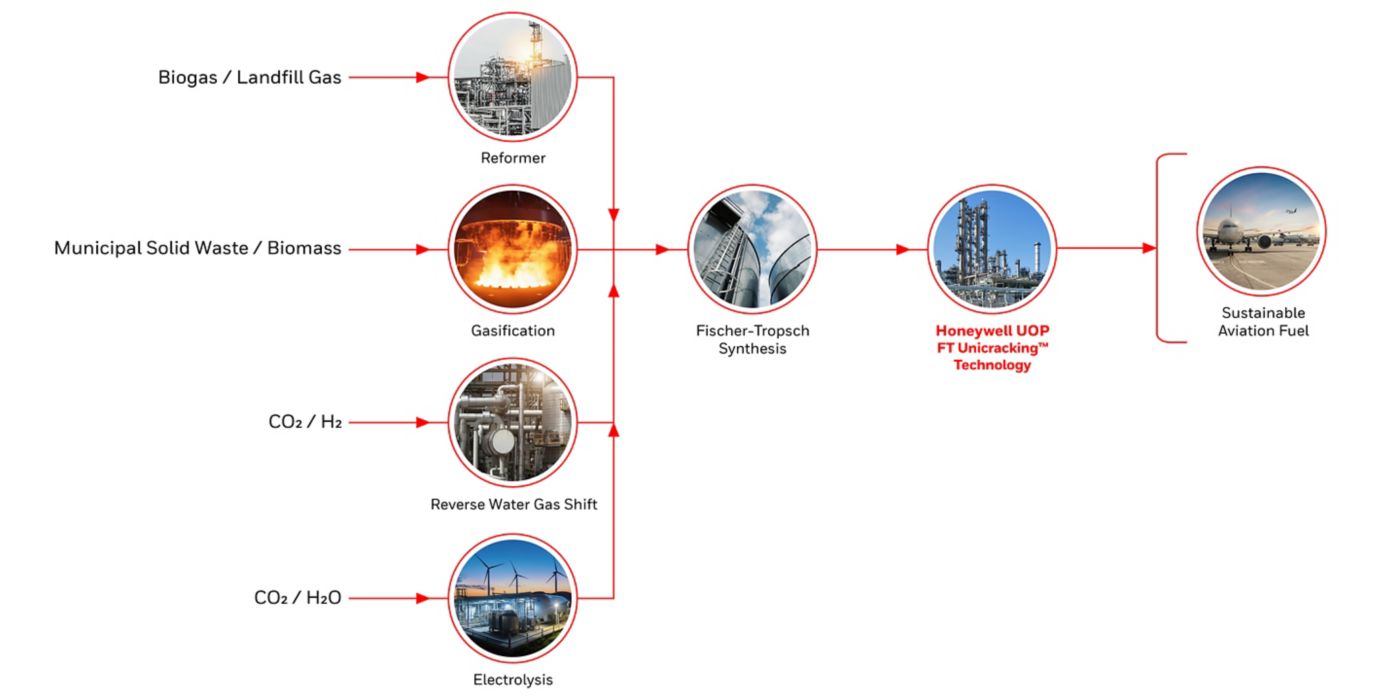
Honeywell's new FT Unicracking™ technology converts Fischer-Tropsch liquids and waxes from waste into ASTM-approved sustainable aviation fuel (SAF).
Repurpose Existing Assets to Take Advantage of SAF
Leading the way in Fischer-Tropsch (FT) hydrocracking technologies, Honeywell's new FT Unicracking process uses a combination of proprietary, commercially proven, highly selective hydrocracking and hydroisomerization catalysts to produce 3-5% more sustainable aviation fuel (SAF)1,2, reduce by-product waste and achieve up to 20% cost reduction compared to other commonly used FT-hydrocracking methods.3,4 FT Unicracking, which can be used both for new units or retrofits, is Honeywell’s latest addition to its Renewable Fuels technology portfolio consisting of the industry leading Ecofining™ suite of solutions, Ethanol-To-Jet and UOP eFining™ (Methanol-to-Jet).
How FT Unicracking Technology Works
FT Unicracking converts liquids and waxes from multiple waste sources into Fischer-Tropsch Synthetic Paraffinic Kerosene (FT-SPK) which is a form of SAF that has been ASTM D7566 approved since June 2009. Viable feedstock sources for FT liquids and waxes include agricultural and/or forestry waste, municipal solid waste, biogas and/or landfill gas, and CO2 combined with hydrogen. FT Unicracking is expected to significantly contribute to meet the growing SAF demand, as a flexible, highly selective, ASTM-approved pathway to SAF. It is a ready-now solution producing a lower carbon SAF product resulting in a high bankability score.
The FT Unicracking Advantage

Higher SAF yield
Produce 3-5% more SAF2,3

Lower CAPEX
Enable a cost reduction of up to 20%3,4

Less waste
Reduce by-product waste streams

90% less carbon intensive1
Process waste biomass

Learn More About Our Sustainable Solutions
While Honeywell is an industry leader in methanol to olefins processing with demonstrated oligomerization and hydrogenation technologies, our unmatched commercial and R&D experience and commitment to creating a sustainable future also extend to the following areas:


Ready To Connect?
Contact us to schedule a meeting with our sales team to discuss how Honeywell UOP can help you
1Carbon intensity is based on ICAO CORSIA default lifecycle emissions values for CORSIA-eligible fuels, Table 1 - agricultural residues and forestry residues. Corsia Eligible Fuels - Life Cycle Assessment Methodology - Version 5 June 2022.
2By utilizing proprietary SAF selective Honeywell UOP hydrocracking and hydro-isomerization catalysts.
3By utilizing a Honeywell patent pending process configuration.
4Based on internal UOP cost (Estimated Erected Cost) analysis that compares a typical configuration with the patent pending configuration.