
What Our Customers’ Priorities Tell Us About Smart Building Management
Laura Laltrello, Vice President and General Manager, Projects, Honeywell Building Technologies
The COVID-19 pandemic, rising cost of living, and other economic challenges, coupled with pressure to reduce carbon emissions, are continuing to reshape the way people work and do business. These forces are also changing the way commercial buildings are operated, used, and experienced.
To achieve sustainability goals and alleviate rising cost pressures, today’s building owners and operators must manage their buildings more effectively and efficiently while also promoting the well-being of occupants. Smart building technology can help achieve these goals, though it may seem daunting when considering the uniqueness of the buildings and the different business priorities, which warrant a different solution for each building site.
Sustainability and Smart Building Tech Top Priority List
Each year, the Honeywell Users Group (HUG) Symposium convenes to allow Honeywell customers to share information, experiences and ideas for enhancing building operations. While the primary goal of the HUG Symposium is to connect users with industry peers, it also presents a unique window into their experiences, challenges, needs, and goals. We let them speak and we listen.
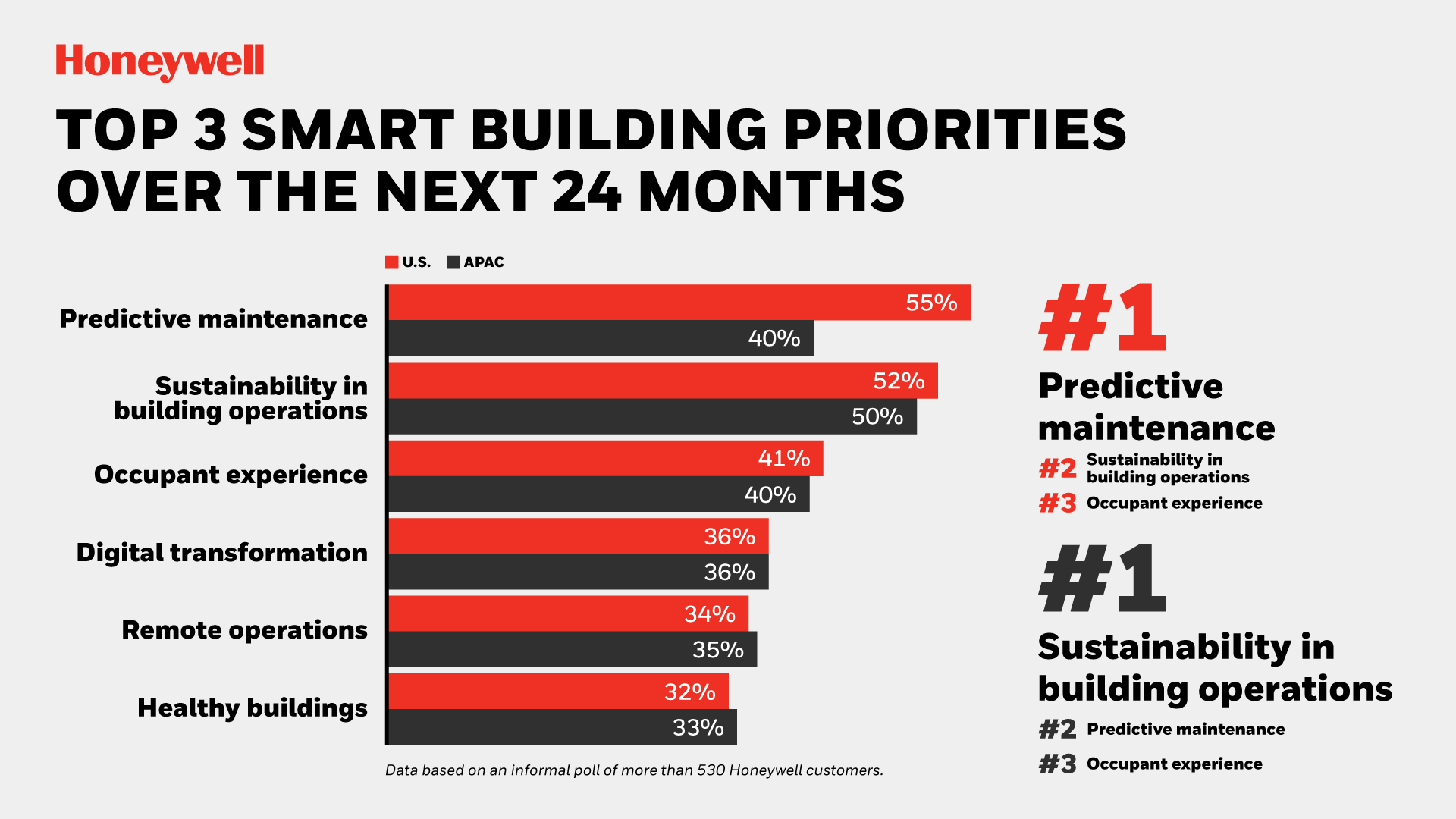
This year, we conducted an informal poll of more than 530 of our customers at events in North America and Australia. We asked attendees in each location about their top-three smart-building priorities over the next 24 months and found some interesting comparisons.
The poll results found that customers in both regions have the same top three priorities but ranked them differently. Predictive maintenance topped the list in North America, followed by sustainability in building operations and the occupant experience. In APAC, sustainability in building operations was most important, followed by the occupant experience and predictive maintenance. Further down the priority list for both regions were projects related to digital transformation, healthy buildings, and remote operations.
Building Managers Face Unprecedented Challenges
Our customers’ priorities and needs tell us they’re facing pressures and challenges on four different fronts:
- Economic pressure: Unpredictable economic conditions are negatively affecting the commercial real estate industry,[i] putting more pressure on building managers to cut costs and increase efficiency in the materials they purchase and the facilities they operate/manage. In the current market, if building owners pay 60-80% [ii] of their gross revenues to cover operating expenses – quite a large bite – this is considered an ‘ideal’ range. To compound matters, a global labor shortage [iii] is making it difficult to find and retain building managers and maintenance workers.
- Environmental pressure: Building managers are also expected to work with stakeholders like CSOs to achieve ESG goals, reduce emissions and meet the demands of more stringent government regulations.
- Well-being-related pressure: COVID-19 has re-shaped the work landscape and more workers are demanding better conditions and experiences within their workplaces. For example, the pandemic has raised awareness of the importance of indoor air quality (IAQ), space utilization, and other workplace factors that can potentially impact well-being.
- New working patterns: The pandemic has also changed the habits and patterns [iv] of many workers, making remote and hybrid schedules more common. A growing number of offices are reconfiguring their workspaces to be more collaborative and flexible for meetings and altering them to accommodate more social space and amenities.
Smart Building Tech Can Help
Fortunately, these pressures also bring a measure of good news. While smart building technology has been around for several decades, it has now reached a tipping point. Honeywell has a wide-ranging toolbox of sophisticated, customized, tech-driven solutions – including hardware, software, and services – that can significantly simplify decision-making and solve for multiple building management constraints at once. This tool-suite can unify and normalize data from disparate sources to make rapid, informed, and often automated decisions. We are helping customers meet economic, environmental, and occupant needs for their buildings.
It’s become increasingly clear, especially since the pandemic, that buildings have a profound effect on both the occupants who inhabit them and the planet that supports them. This heightened awareness is helping to drive the rapid evolution of smart building technology. The more we can take the opportunity to listen carefully to our customers, the better equipped we’ll be to help them find the right solutions to simplify their lives, improve their occupants’ well-being, and build and manage more sustainable solutions.
[i] CBRE, Estimating the Impact of Inflation on Commercial Real Estate Returns, Neil Blake, Matt Mowell and Jing Ren, June 14, 2021. [Accessed August 1, 2022.]
[ii] Investopedia, Operating expense ratio (OER): definition, formula and example, Adam Hayes, updated September 27, 2020. [Accessed October 17, 2022.]
[iii] Project Management Institute, Global Megatrends 2022: Labor Shortages, 2022. [Accessed August 31, 2022.]
[iv] Gartner, 9 Future of Work Trends Post Covid-19, Jordan turner and Mary Baker, June 16, 2022. [Accessed August 31, 2022.]