

-
-
Need a Honeywell Account?
Create an AccountAlready have a Honeywell account?
Sign In -
Home My Account Order Management Invoice Management Case Management Saved Carts Address Book Legacy myTransactions Price Agreement Wishlist Advanced Search Preferred Business EntitymyProcess Home My Account Favorites Saved Cart Address Book Order Management Invoice Management Quote History Discount History Service ContractsMy Account My Profile My Orders My Orders Shop My Quotes My Returns Saved Carts Return Requests Invoices My Contracts Case History Work Order History My Subscriptions My Assets Manage Trainings & UsersHome Account Case Management Order Management Saved Carts Favorites Address Book Asset Management Quote ManagementCurrency:Localize your Content
You can set your preferred currency for this account.
Currency- CHOOSE YOUR CURRENCY
Update Currency
Changing Currency will cause your current cart to be deleted. Click OK to proceed.
To Keep your current cart, click CLOSE and then save your cart before changing currency.
Select AccountSwitching accounts will update the product catalog available to you. When switching accounts, your current cart will not move to the new account you select. Your current cart will be available if you log back into this account again.
Account# Account Name City Zip/Post Code PROCEEDCANCELMy Account
-
You are browsing the product catalog for
You are viewing the overview and resources for
to view parts associated with your account
How Trash and Food Waste Could Help Power Planes
Learn about a pathway to sustainable aviation fuel (SAF) that uses everyday trash and leftovers from crops, wood pieces and food waste as feedstock
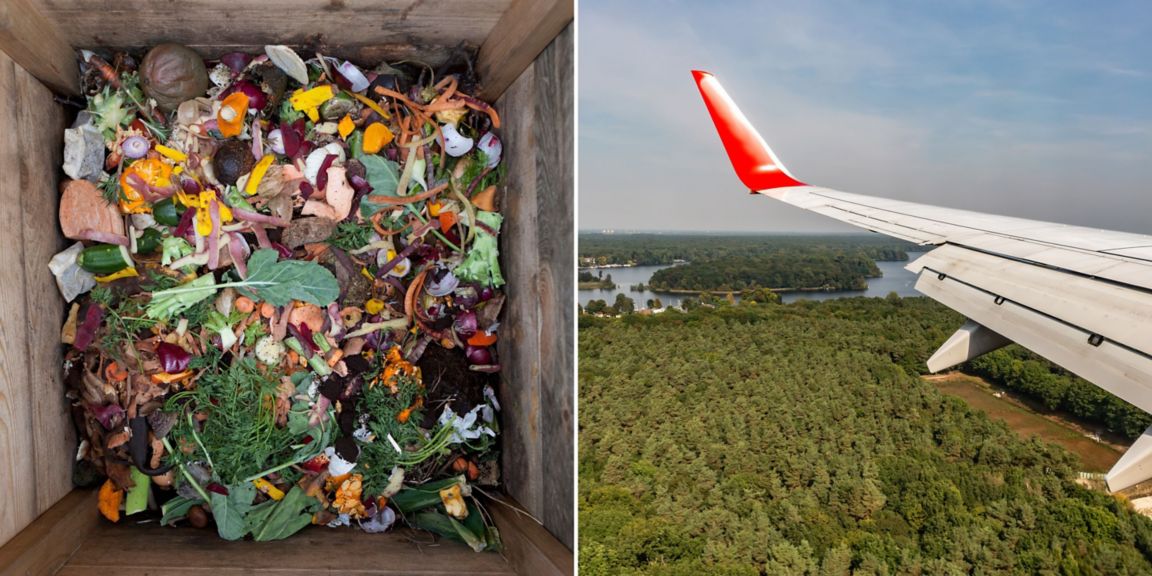
The next time you take out the trash, know that those leftover food scraps could help contribute to future sustainable aviation fuel (SAF) production.
Honeywell’s technology uses solid waste, which you probably know as garbage or trash; and biomass, or waste from forest and agricultural sites, to develop SAF that is 90% less carbon intensive than traditional jet fuels.1
How it works: The technology uses trash and waste biomass – which includes leftovers from crops, wood pieces or food scraps – as feedstock to create SAF. The technology produces 3-5% more SAF compared to other commonly used technologies.2
SAF can be made from a variety of sources, or feedstocks, such as used fats, oils and greases, waste biomass, and other waste materials. The result is a lower-carbon alternative to conventional jet fuel that, today, can be mixed with up to 50% of traditional jet fuel to power an aircraft and is compatible with current airport and fueling infrastructure, making it a drop-in solution.
Why it’s impactful: Globally, the aviation industry commits to reaching net-zero carbon emissions by 2050. The International Air Transport Association estimates that SAF could contribute around 65% of the emissions reduction needed for the aviation sector to reach its net-zero goal. Due to constraints of fats, oils and greases available globally to be used as feedstocks, multiple technology pathways will be needed to meet the expected demand for SAF.
Using biomass and municipal solid waste (in other words, trash) as feedstock is an especially viable route for SAF production because it uses widely abundant materials.
What else to know about renewable fuels: Honeywell has also developed technologies that can help convert ethanol (from corn, sugarcane or other crops) into SAF; as well as Honeywell UOP EcofiningTM, a process that uses waste fats, oils and greases to develop SAF. Additionally, the Honeywell UOP eFiningTM process converts green hydrogen and carbon dioxide into electrofuels (eFuels for short), which are a class of renewable fuels that can replace conventional jet fuel.
Learn more in this podcast episode about pathways to SAF production.
1Carbon intensity is based on ICAO CORSIA default lifecycle emissions values for CORSIA-eligible fuels, Table 1 - agricultural residues and forestry residues. Corsia Eligible Fuels - Life Cycle Assessment Methodology - Version 5 June 2022.
2 By utilizing proprietary SAF selective Honeywell UOP hydrocracking and hydro-isomerization catalysts.
Copyright © 2026 Honeywell International Inc

Maximum File Size
Maximum Files Exceeded
Due to inactivity you will be logged out in 000 seconds.
Maximum File Size
Maximum Files Exceeded
You cannot access this page as this product is not available in your country.
Maximum File Size
Maximum Files Exceeded
This product is not available in your country.
You cannot access this page as this product is not available in your current country. To view this product, please change your product catalog view.

We use cookies and similar tracking online technologies to improve website performance, record website activities, facilitate information sharing on social media and offer advertising tailored to your interest. For more information, see our Cookie Notice and Terms and Conditions. You can also customize your browser’s cookie settings. Please note that if you refuse cookies, it may affect site functionality and performance.