

-
-
Need a Honeywell Account?
Create an AccountAlready have a Honeywell account?
Sign In -
Home My Account Order Management Invoice Management Case Management Saved Carts Address Book Legacy myTransactions Price Agreement Wishlist Advanced Search Preferred Business EntitymyProcess Home My Account Favorites Saved Cart Address Book Order Management Invoice Management Quote History Discount History Service ContractsMy Account My Profile My Orders My Orders Shop My Quotes My Returns Saved Carts Return Requests Invoices My Contracts Case History Work Order History My Subscriptions My Assets Manage Trainings & UsersHome Account Case Management Order Management Saved Carts Favorites Address Book Asset Management Quote ManagementCurrency:Localize your Content
You can set your preferred currency for this account.
Currency- CHOOSE YOUR CURRENCY
Update Currency
Changing Currency will cause your current cart to be deleted. Click OK to proceed.
To Keep your current cart, click CLOSE and then save your cart before changing currency.
Select AccountSwitching accounts will update the product catalog available to you. When switching accounts, your current cart will not move to the new account you select. Your current cart will be available if you log back into this account again.
Account# Account Name City Zip/Post Code PROCEEDCANCELMy Account
-
You are browsing the product catalog for
You are viewing the overview and resources for
to view parts associated with your account
Hall-effect Sensors vs. Anisotropic Magnetoresistance (AMR) Sensors
Magnetic sensors are used for many years, but do you know what the latest model can do? Find out everything about Anisotropic Magnetoresistance Sensors.

Magnetic sensors have been a staple for many years in various applications. They convert magnetic or magnetically encoded information into electrical signals for processing by electronic circuits.
In automotive systems alone they’ve been used for the sensing of position, distance and speed. For example, the position of the car seats and seat belts for air-bag control or wheel speed detection for the anti-lock braking system (ABS).
Hall-effect sensors in particular have been used for applications in detecting speed, position, and direction of travel for a target. But the newer kids on the block - Anisotropic Magnetoresistance (AMR) Sensors - are giving them a run for the money.
AMR sensors:
- Have higher sensitivity than a Hall Effect sensor
- Are triggered by either a north or south pole (omnipolar sensing)
- Have increased resolution when using a ring magnet with the same number of poles as Hall Effect sensors
- Have the same resolution as Hall Effect sensors with a much larger air gap, even with a reduced number of poles
On the other hand, Hall-effect sensors have a proven track record in applications requiring tighter operating characteristics. And for applications requiring flexibility, external circuitry has allowed it to operate outside perceived parameters.
Both sensor types continue to offer non-contact, wear free operation, low maintenance cost, robust design, and immunity to vibration, dust, and water.
So … which do you choose for your application? Maybe taking a look at the individual technologies will shed some light.
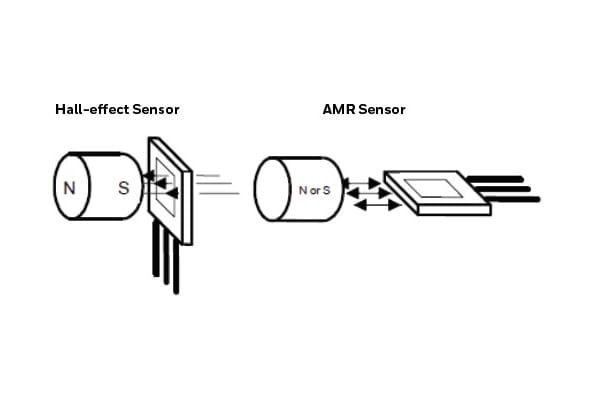
Hall-effect sensors respond to magnetic fields perpendicular to the sensor. AMR sensors respond to parallel fields, and react to both magnetic poles.
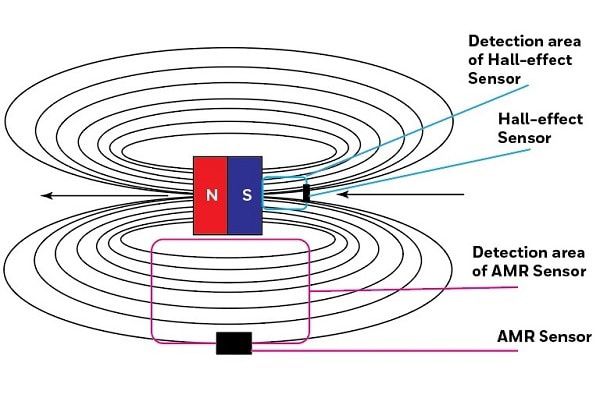
Or, with a slightly different view, you can see the AMR comes with an inherent range of applications and detection area that Hall-effect sensors can only achieve with additional circuitry.
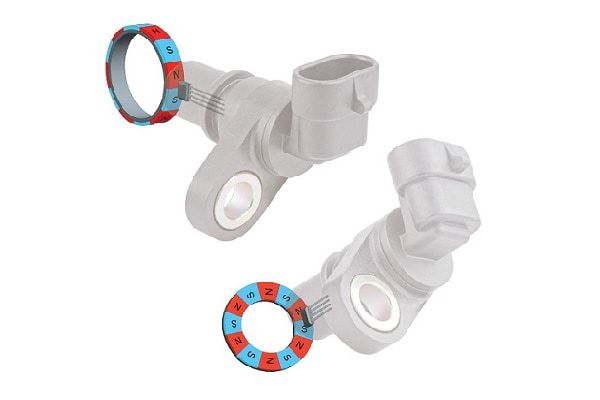
The right sensor housing designed for the right application makes for an unbeatable, durable, long-lasting solution.
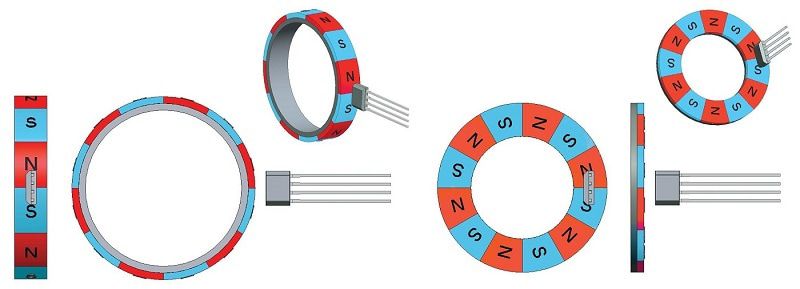
The design flexibility of the AMR Sensor, because of its ability to detect a horizontal magnetic field and omnipolar sensitivity, means you can provide the magnetic fields in many ways.
There may not be a clear winner for your application. In that case, you win either way. Hall-effect sensors have been around for a long time. They’ve been custom fit with additional circuitry to overcome many perceived limitations. If your application fits that bill, you may want to consider sticking with what works.
Also remember that inherent Hall-effect Sensor limitations may be just what the sensor doctor ordered for your application. If you need a sensor with a small detection range and presentation area, trying to apply AMR Sensors would simply require additional circuitry and processing.
The good news is that more players mean more opportunities to apply a solution directly, or with just minor modifications. Happy sensing!
Copyright © 2026 Honeywell International Inc

Maximum File Size
Maximum Files Exceeded
Due to inactivity you will be logged out in 000 seconds.
Maximum File Size
Maximum Files Exceeded
You cannot access this page as this product is not available in your country.
Maximum File Size
Maximum Files Exceeded
This product is not available in your country.
You cannot access this page as this product is not available in your current country. To view this product, please change your product catalog view.

We use cookies and similar tracking online technologies to improve website performance, record website activities, facilitate information sharing on social media and offer advertising tailored to your interest. For more information, see our Cookie Notice and Terms and Conditions. You can also customize your browser’s cookie settings. Please note that if you refuse cookies, it may affect site functionality and performance.