

-
-
Need a Honeywell Account?
Create an AccountAlready have a Honeywell account?
Sign In -
Home My Account Order Management Invoice Management Case Management Saved Carts Address Book Legacy myTransactions Price Agreement Wishlist Advanced Search Preferred Business EntitymyProcess Home My Account Favorites Saved Cart Address Book Order Management Invoice Management Quote History Discount History Service ContractsMy Account My Profile My Orders My Orders Shop My Quotes My Returns Saved Carts Return Requests Invoices My Contracts Case History Work Order History My Subscriptions My Assets Manage Trainings & UsersHome Account Case Management Order Management Saved Carts Favorites Address Book Asset Management Quote ManagementCurrency:Localize your Content
You can set your preferred currency for this account.
Currency- CHOOSE YOUR CURRENCY
Update Currency
Changing Currency will cause your current cart to be deleted. Click OK to proceed.
To Keep your current cart, click CLOSE and then save your cart before changing currency.
Select AccountSwitching accounts will update the product catalog available to you. When switching accounts, your current cart will not move to the new account you select. Your current cart will be available if you log back into this account again.
Account# Account Name City Zip/Post Code PROCEEDCANCELMy Account
-
You are browsing the product catalog for
You are viewing the overview and resources for
to view parts associated with your account
Prevent Battery Failures with Mitigation | Honeywell Building Solutions
Learn how Honeywell's Li-ion Tamer prevents lithium-ion battery failures with mitigation strategies.
Gian Valli

Lithium ion battery failure follows four primary stages, which are initial abuse, off-gas generation, smoke generation, and fire propagation. Both the initial abuse and off-gas generation stages fall within what’s called the “preventative region”. In that region, specifically during the off-gas stage, implementing proper mitigating actions can help prevent battery failure. As such, integrating Li-ion Tamer for off-gas detection is essential to protecting battery systems.
Li-ion Tamer acts as an additional monitoring system, in addition to the battery management system (BMS) and fire panel. The output signals from Li-ion Tamer can either be tied into the BMS, fire panel, or other control systems. As shown in the image below, it’s an extra layer of defense and can even provide a “golden time”, during which proper mitigating actions can halt battery failure.
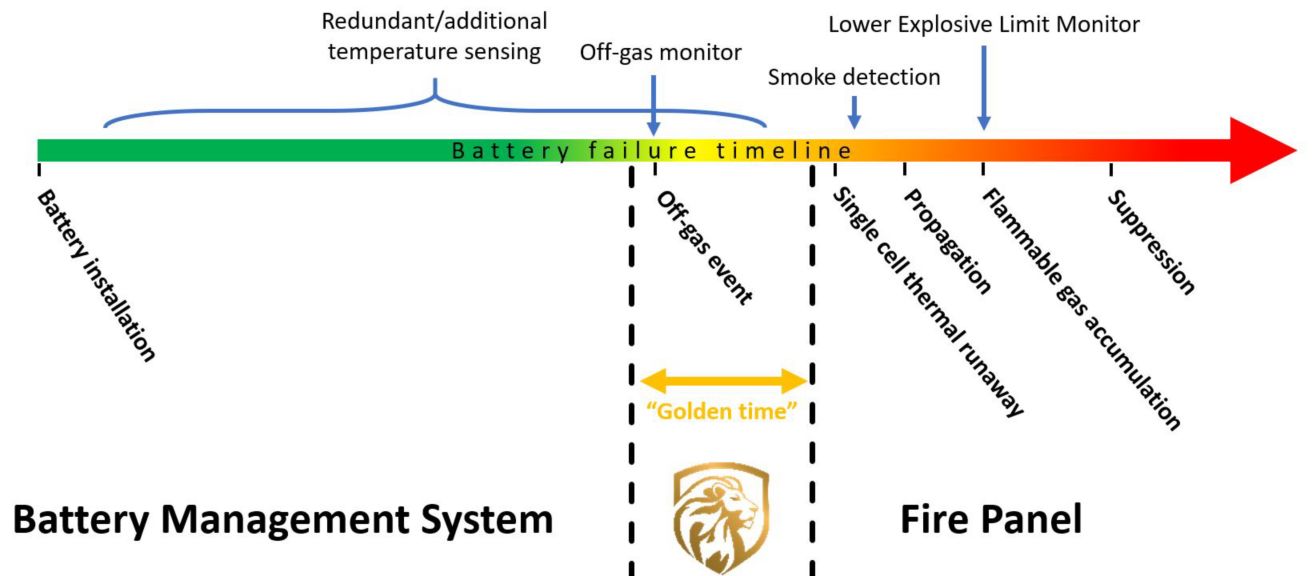
Lithium ion battery failure follows four primary stages, which are initial abuse, off-gas generation, smoke generation, and fire propagation. Both the initial abuse and off-gas generation stages fall within what’s called the “preventative region”. In that region, specifically during the off-gas stage, implementing proper mitigating actions can help prevent battery failure. As such, integrating Li-ion Tamer for off-gas detection is essential to protecting battery systems.
Li-ion Tamer acts as an additional monitoring system, in addition to the battery management system (BMS) and fire panel. The output signals from Li-ion Tamer can either be tied into the BMS, fire panel, or other control systems. As shown in the image below, it’s an extra layer of defense and can even provide a “golden time”, during which proper mitigating actions can halt battery failure.
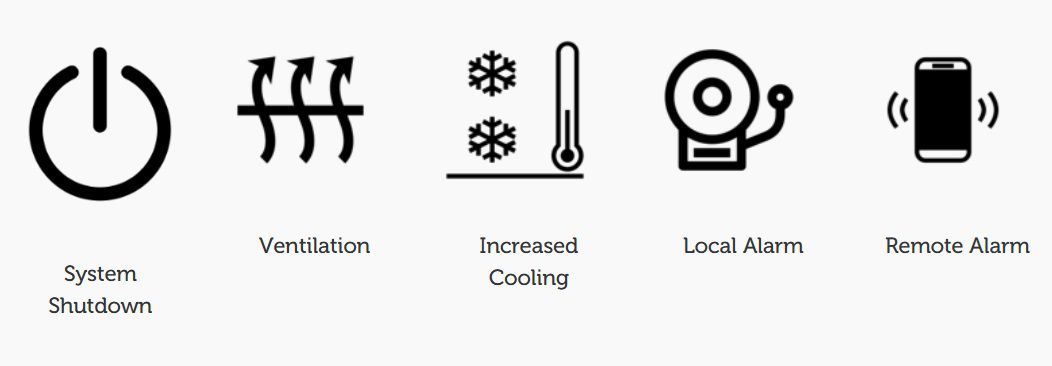
Although there are a variety of possible mitigating actions, the most important is a system shutdown. However, the industry has many different definitions of what exactly this entails. As such, to help prevent battery failure, forced charge and discharge of the batteries must stop. Usually shutdown applies to the whole ESS, but certain system designs can allow only sub-sections of racks to require shutdown.
Aside from system shutdowns, increased ventilation at the module-level and system-level is also a highly recommended mitigating action. Helping clear gases from the battery modules can help reduce Li-ion Tamer sensor response time. Also, ventilating the gases from the system will reduce the risk of creating an explosive environment.
Overall, when implementing mitigating actions, it’s important to focus on removing potential abuse factors from the batteries early during abuse. As such, early warning from Li-ion Tamer off-gas detection can help halt catastrophic battery failure before it begins.
If you are interested in learning more about our product and how to integrate it into your systems to prevent thermal runaway, please contact us.

Gian Carlo is an Applications Engineer and works primarily on the Li-ion Tamer® product line. He has a B.S. in Mechanical Engineering from The Ohio State University with a focus on product design. His experience testing lithium ion batteries has given him an in-depth understanding of the best practices for Li-ion Tamer applications.

Battery Failure Prevention with Proper Mitigating Actions
Copyright © 2026 Honeywell International Inc

Maximum File Size
Maximum Files Exceeded
Due to inactivity you will be logged out in 000 seconds.
Maximum File Size
Maximum Files Exceeded
You cannot access this page as this product is not available in your country.
Maximum File Size
Maximum Files Exceeded
This product is not available in your country.
You cannot access this page as this product is not available in your current country. To view this product, please change your product catalog view.

We use cookies and similar tracking online technologies to improve website performance, record website activities, facilitate information sharing on social media and offer advertising tailored to your interest. For more information, see our Cookie Notice and Terms and Conditions. You can also customize your browser’s cookie settings. Please note that if you refuse cookies, it may affect site functionality and performance.