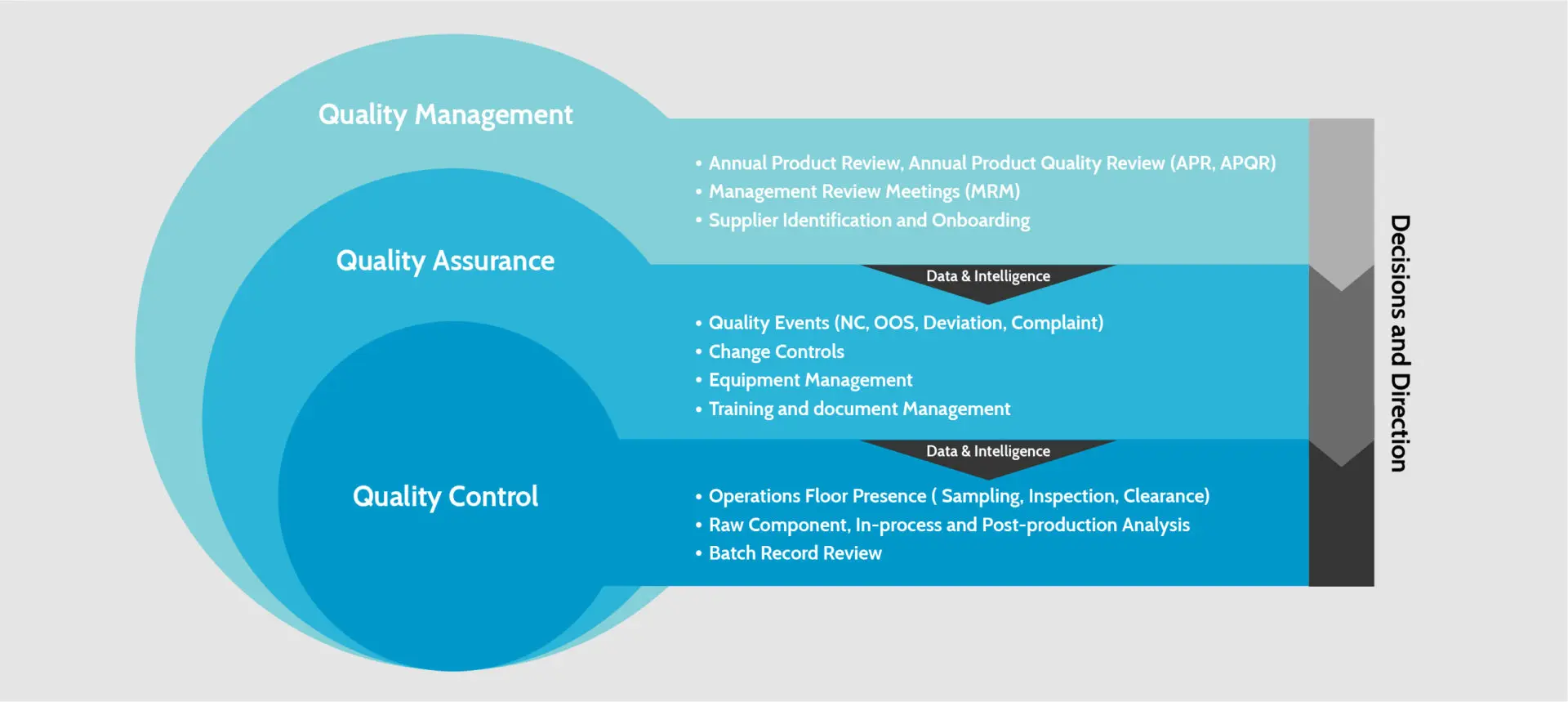
Qualiy Control Maturity
Quality control describes the steps that are taken to make sure that only product that complies with the approved/accepted specifications is released for subsequent use or processing. In a mature quality control program, you can:
- Consistently identify product that is nonconforming or out of spec.
- Quickly escalate captured quality data to quality assurance decision-makers
- Accurately determine both root cause and necessary corrective actions
- Identify any issues with equipment before they affect product quality.
Warning signs of an immature quality control program include:
- Failure to identify product quality issues before market impact
- Inconsistent classification of product quality issues
- Significant equipment failures that harm product quality and escape detection
An unusual or unexpected distribution of complaints across batches, ranges or sites can indicate problems with process variation or process control. By comparing the Standard Deviation and Mean of Complaints per Batch for a product, insight into the suitability of process and product control can be ascertained.
For example, the Standard Deviation being greater than the Mean would indicate some batches having complaint counts potential two, three, even 10 times the complaints count for other batches. That sort of complaint-by-batch distribution would suggest failure to identify nonconforming product prior to release —a sign of immature quality control—or allowing nonconforming product to be released—a hallmark of immature quality assurance.
Quality Assurance Maturity
Quality assurance not only supports and enables production operations but also handles and responds to quality control escalations. In a mature quality assurance program,
- Quality control issues are consistently addressed within risk classes.
- Reportable product quality issues are identified and promptly escalated, as needed.
- Quality control escalation is reported to the appropriate agency in a timely fashion.
- Investigations result in determination of a true root cause and actionable corrections.
Immature quality assurance results in less-than-thorough investigations and misidentification of both root cause and appropriate corrections. Product quality issues result in variable outcomes and are under-reported to the responsible agency.
To identify an immature quality assurance system, watch out for the following:
- Over-classification of records, which can suppress the identification of trends and relationships, leading to ineffective CAPA or repeating product quality issues.
- High rates of root causes related to “human” causes – User operator training, procedure incorrect or not followed and similar root cause categories may indicate inadequate training that doesn’t differentiate between qualified and unqualified personnel and doesn’t prevent unqualified personnel from handling product or making decisions.
- Frequent revision of procedures and other documents, which may suggest trial-and-error “development” of SOP, test methods, batch processing instructions and other reference documents.
- Rapid onboarding of new hires, with irregular training completion and per-day SOP read rates.
- Large volumes of Planned Deviations, a greater than expected ratio of processes with planned deviation (or temporary change control) compared to processes without planned deviation.