Three ways to assess your Quality Maturity
June 8, 2020
June 8, 2020

Quality maturity plays a key role in both the FDA Center for Drug Evaluation and Research (CDER) Pharmaceutical Quality for the 21st Century initiative and the Center for Device and Radiological Health (CDRH) Case for Quality initiative. But how can a quality system be assessed for maturity?
Here’s what we’ve discovered.
What Does “Mature” Look Like?
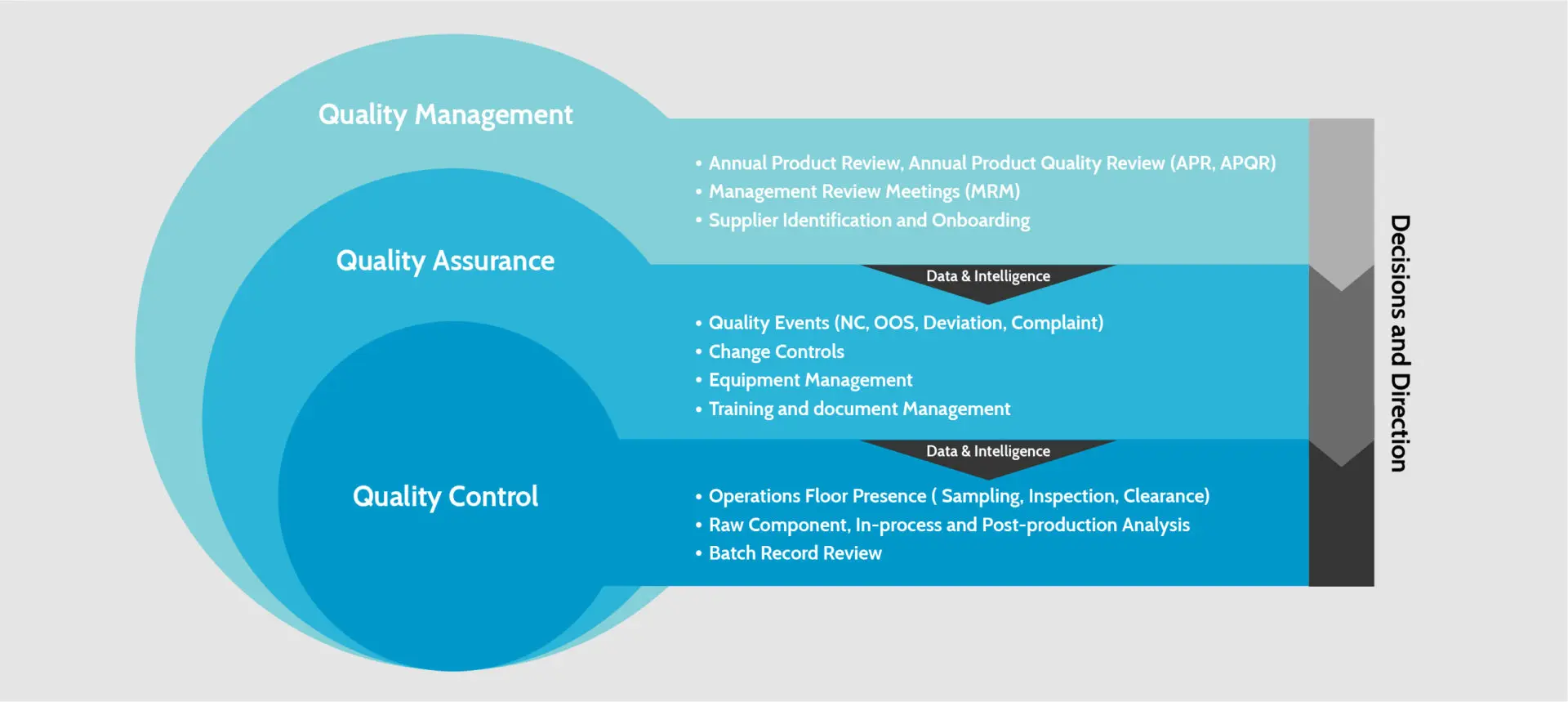
The overall maturity of your quality system depends on the maturity in each of three operational layers:
In a mature quality system, each layer has clear, well-defined processes and responsibilities. Information and data move between layers in a rational, predetermined way, triggering cascading evaluations and actions.
However, maturity in one layer can mask signs of trouble in another. Knowing which red flags indicate immaturity at each level can help you pinpoint and correct such problems
Qualiy Control Maturity
Quality control describes the steps that are taken to make sure that only product that complies with the approved/accepted specifications is released for subsequent use or processing. In a mature quality control program, you can:
Warning signs of an immature quality control program include:
An unusual or unexpected distribution of complaints across batches, ranges or sites can indicate problems with process variation or process control. By comparing the Standard Deviation and Mean of Complaints per Batch for a product, insight into the suitability of process and product control can be ascertained.
For example, the Standard Deviation being greater than the Mean would indicate some batches having complaint counts potential two, three, even 10 times the complaints count for other batches. That sort of complaint-by-batch distribution would suggest failure to identify nonconforming product prior to release —a sign of immature quality control—or allowing nonconforming product to be released—a hallmark of immature quality assurance.
Quality Assurance Maturity
Quality assurance not only supports and enables production operations but also handles and responds to quality control escalations. In a mature quality assurance program,
Immature quality assurance results in less-than-thorough investigations and misidentification of both root cause and appropriate corrections. Product quality issues result in variable outcomes and are under-reported to the responsible agency.
To identify an immature quality assurance system, watch out for the following:
Quality Management Maturity
Quality management ensures that adequate resources are available for the production and control of quality product. Immaturity in quality control or assurance automatically indicates immature quality management, which is responsible for:
Aside from signs of immaturity in quality control or assurance, how can you identify immature quality management?
Daniel Burns is a Director of Product Management. Dan brings a wide breadth of industry experience coupled with practical knowledge as an end user of TrackWise and TrackWise Digital. He is very knowledgeable of the current FDA, EMEA and Health Canada regulations regarding manufacturing operations, packaging operations, quality control, R&D, warehouse management and distribution practices.