

-
-
Need a Honeywell Account?
Create an AccountAlready have a Honeywell account?
Sign In -
Home My Account Order Management Invoice Management Case Management Saved Carts Address Book Legacy myTransactions Price Agreement Wishlist Advanced Search Preferred Business EntitymyProcess Home My Account Favorites Saved Cart Address Book Order Management Invoice Management Quote History Discount History Service ContractsMy Account My Profile My Orders My Orders Shop My Quotes My Returns Saved Carts Return Requests Invoices My Contracts Case History Work Order History My Subscriptions My Assets Manage Trainings & UsersCurrency:Localize your Content
You can set your preferred currency for this account.
Currency- CHOOSE YOUR CURRENCY
Update Currency
Changing Currency will cause your current cart to be deleted. Click OK to proceed.
To Keep your current cart, click CLOSE and then save your cart before changing currency.
Select AccountSwitching accounts will update the product catalog available to you. When switching accounts, your current cart will not move to the new account you select. Your current cart will be available if you log back into this account again.
Account# Account Name City Zip/Post Code PROCEEDCANCELMy Account
-
You are browsing the product catalog for
You are viewing the overview and resources for
to view parts associated with your account

Small Particles in the Air Can Cause Big Health Problems
Honeywell's laser-based sensors are the solution for the air pollution that can help you prevent big health problems that can threaten your family. Find out more.
Honeywell
August 9, 2019
We spend much of our time indoors, and want that indoor air to be as clean as possible. But that air is often filled with small particles a fraction of the diameter of a human hair. Because they are so small, they can lodge deep in our lungs, potentially causing long term illnesses.
In other words, particulate matter doesn’t have to be big to cause big health problems. These particles are categorized as PM10 (10 micrometers or smaller) and PM2.5 (2.5 micrometers or smaller).
Here are a few sources of particulate matter floating around indoors:
- smoking
- cooking
- open flames from appliances, burning candles, and other sources
- pollen and mold
- using kerosene heaters
- diffusing essential oils
- cleaning using common chemical products
- opening doors and windows to outdoor polluted environments
- using hairsprays, aerosol room fresheners or deodorants
Air that has a high particulate count can trigger asthma attacks, as well as lead to irritated eyes, nose and throat, shortness of breath, coughing, heart disease, and other health-related issues. Prolonged exposure can be especially dangerous to young children, seniors, and individuals with compromised immune systems or respiratory problems
Because of potential health problems caused by particulate matter, many governments are regulating what’s allowed in our air. The problem has been that these particles were previously only detectible with electron microscopes. Since most households and businesses don’t have electron microscopes available, new particle sensors are increasingly filling that role.
Laser-based sensors detect and count particles with light scattering. A laser light source illuminates a particle as it is pulled through a detection chamber. As particles pass through the laser beam, the light reflects off the particles and is recorded on a photo or light detector. The light is then analyzed and converted to an electrical signal for use by another system.
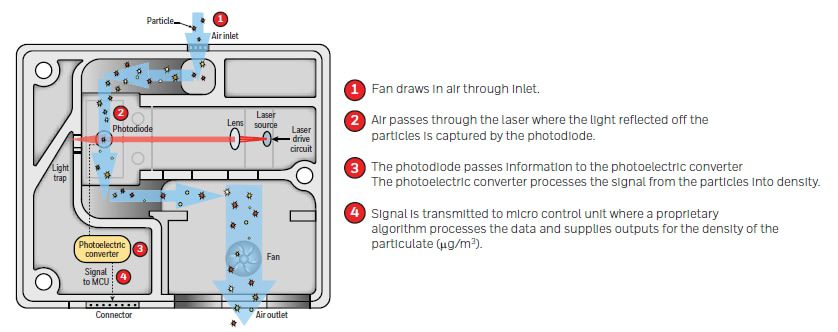
The electrical signal can be fed into heating, ventilation, and air conditioning (HVAC) control systems in buildings and homes, or into other air monitoring devices to automatically clean the air. Or, the signal can alert family members or building operators that air purification systems should be activated, if outdoor air could be used to improve indoor air quality, when an air filter needs to be changed, or when early maintenance should be performed on indoor air delivery systems.
Because the sensors can easily fit in the palm of your hand, they can be integrated in many home appliances as well as larger air purification systems.
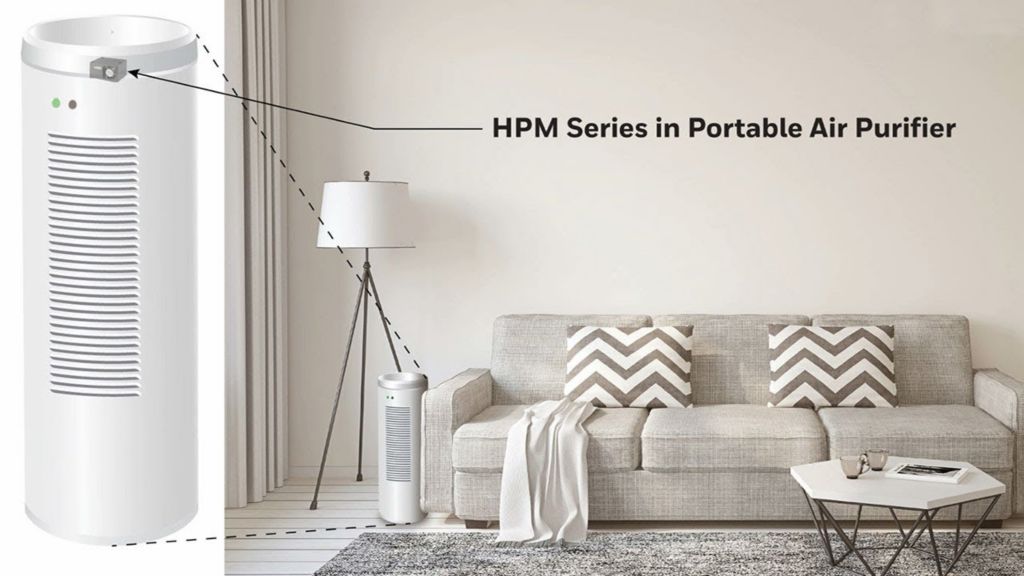
We no longer have to be at the mercy of what’s in the air. Now we can proactively detect and clean the air with minimal power and space requirements before the air causes problems.

Copyright © 2026 Honeywell International Inc

Maximum File Size
Maximum Files Exceeded
Due to inactivity you will be logged out in 000 seconds.
Maximum File Size
Maximum Files Exceeded
You cannot access this page as this product is not available in your country.
Maximum File Size
Maximum Files Exceeded
This product is not available in your country.
You cannot access this page as this product is not available in your current country. To view this product, please change your product catalog view.

We use cookies and similar tracking online technologies to improve website performance, record website activities, facilitate information sharing on social media and offer advertising tailored to your interest. For more information, see our Cookie Notice and Terms and Conditions. You can also customize your browser’s cookie settings. Please note that if you refuse cookies, it may affect site functionality and performance.