

BIOCRUDE UPGRADING BIOMASS TO RENEWABLE FUEL
Honeywell’s next generation renewable fuels processing technology produces drop-in renewable aviation, marine, and road transportation fuels from abundant and lower-cost biomass sources.
Rising global demand for renewable fuels is prompting the search for new feedstocks. Waste wood and plant residues from agriculture, forestry, and other industries—known as lignocellulosic biomass—can be an abundant and inexpensive renewable fuel feedstock. This low-cost biomass source can be processed using Honeywell UOP’s Biocrude Upgrading to produce renewable marine, aviation and road fuels.

VIDEO
Introducing UOP Biocrude Upgrading
Discover Honeywell’s next-generation renewable fuel processing technology.
Explore Renewable Fuels Produced With Biocrude Upgrading
- Renewable Marine Fuel
- Sustainable Aviation Fuel
- Renewable Naphtha



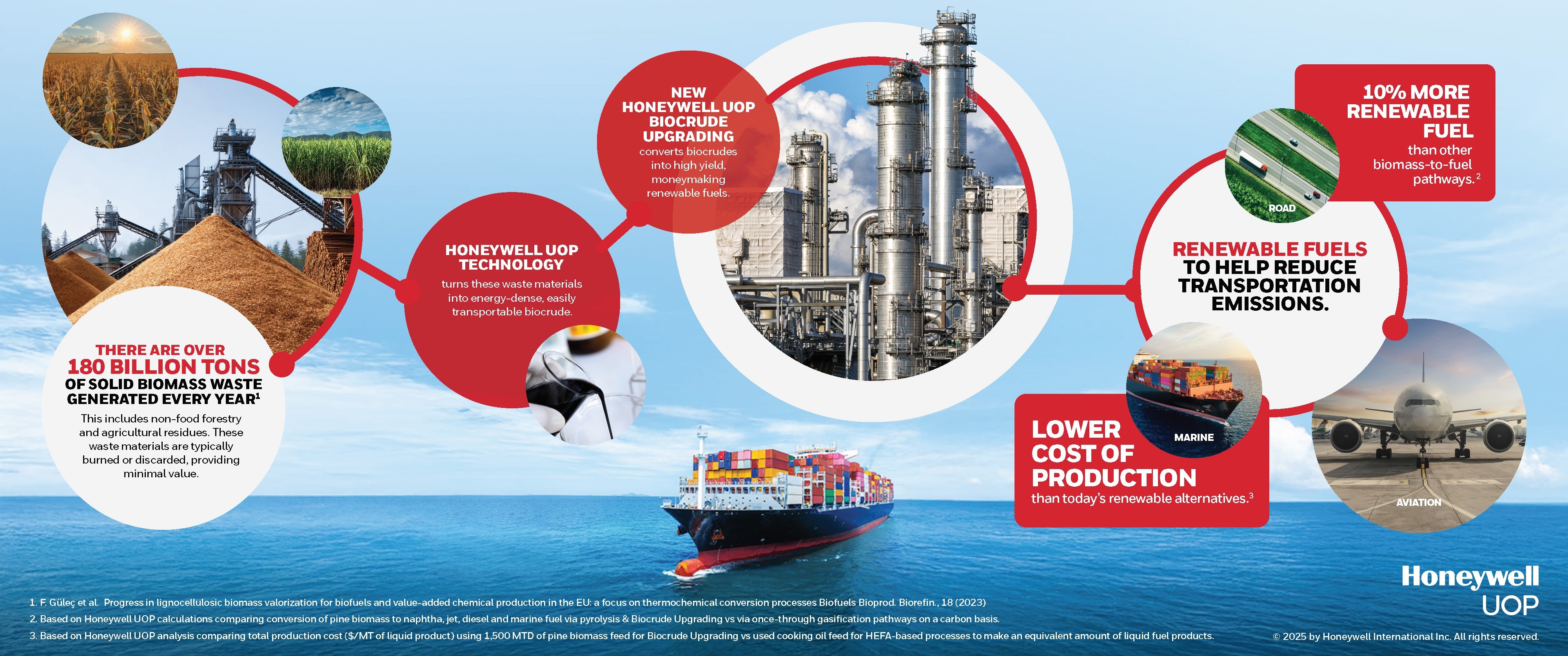
Utilizing an innovative reactor and catalyst system, UOP Biocrude Upgrading uses pyrolysis oil (pyoil) or hydrothermal liquefaction (HTL) oil as an intermediate between waste biomass and transportation fuels. UOP Biocrude Upgrading can offer:
An innovative pathway to access abundant, lower-cost biomass feedstock
The ability to produce renewable marine fuel and SAF with a lower cost of production than HEFA-based fuels2
- Up to 10% higher carbon yield from biomass versus a once-through gasification process3
- An adjustable process design to maximize renewable marine fuel or SAF products
- Modular delivery to help reduce project and scheduling risk
Explore More Renewable Fuel Solutions
-
RTP Technology For Biomass Conversion
-
Honeywell UOP eFining™




Our Headquarters
855 S. Mint Street
Charlotte, North Carolina, US
Follow Us
1Reduced GHG emissions is based on Honeywell UOP carbon intensity analysis of renewable marine fuel production using pine biomass in the Biocrude Upgrading process, compared to fossil marine fuel production.
2Based on Honeywell UOP analysis comparing total production cost ($/MT of liquid product) using 1,500 MTD of pine biomass feed for Biocrude Upgrading vs used cooking oil feed for HEFA-based processes to make an equivalent amount of liquid fuel products.
3Based on Honeywell UOP calculations comparing conversion of pine biomass to naphtha, jet, diesel and marine fuel via pyrolysis & Biocrude Upgrading vs via once-through gasification pathways.
